
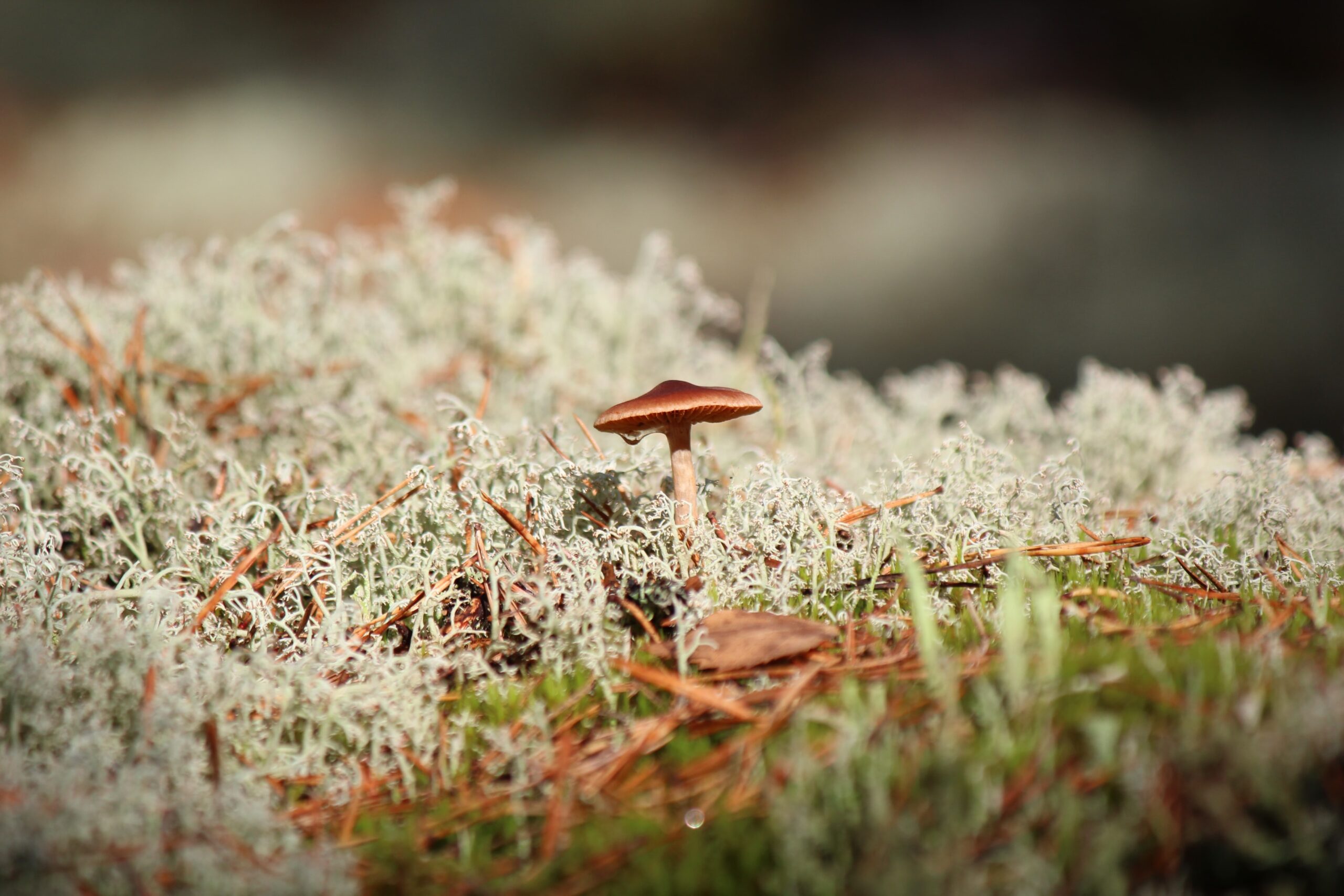
Graduate Student, Michael Malone is an MMS Scholarship recipient. He recently spoke to the MMS about his studies.
The Phylogeography of Polynesian Xylariales
Polynesian fungi are poorly documented, and the deficit in biological data is even greater in Polynesian taxa of understudied groups such as the Xylariales (dead man’s fingers, cramp balls, etc.).
Studying Polynesian fungi in general is important for understanding the evolutionary relatedness of these fungi to continental types. To help reach this goal, Michael developed a branching evolutionary diagram (a cladogram) with a global distribution of Xylariales, including Polynesian representatives sequenced during his thesis.
Additionally, he conducted a biogeographical signaling analysis to assess the immediate genetic similarity of Polynesian taxa to matching sequences on a global scale. The signaling analysis suggests that Neotropical (South America) and Indo-Malayan (Southeast Asia) fungi have the closest genetic similarity to Polynesian types.
However, the results may be biased toward these regions since two of the greatest living Xylariales experts, Roo Vandegrift and Yu-Ming Ju, have conducted extensive research in Ecuador and Taiwan, respectively.
On the other hand, the cladogram is inconclusive due to a lack of genetic coverage and missing location data in previous studies on Xylariales. In any case, colonization of Polynesian islands by Xylarialean fungi does occur. The potential dispersal agents are varied, including wind, water, and humans.
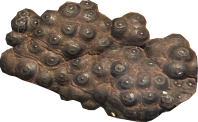
Xylarialean Fungi
Do Laboulbenian Fungi Affect Beetle Behavior?
The Laboulbeniales are among the most poorly studied groups of fungi to date. Among many reasons, the most apparent is their microscopic size and their specialized association with arthropods (mainly beetles).
Many questions about the Laboulbeniales have gone unanswered, including their influence on the behavior of their hosts. Michael organized a lab-based observation experiment with UWL undergraduate Zachary Morgan. The objective was to assess differences in the frequency of grooming/sanitary behaviors and food consumption between beetles with no fungal infection and those with Laboulbenian fungi present.
Beetles of the family Carabidae were collected from a local marsh and scanned for infection before being separated into individual enclosures. The beetles were observed under security cameras for 24 hours and fed ad libitum.
Food was weighed before and after the observation period, and the video was analyzed to document the number of grooming bouts and their durations.
Preliminary results suggest higher rates of food consumption in infected beetles but no significant difference in grooming behaviors. With this data, it is possible that beetles infected with Laboulbeniales expend more energy than uninfected beetles and, therefore, need to eat more.
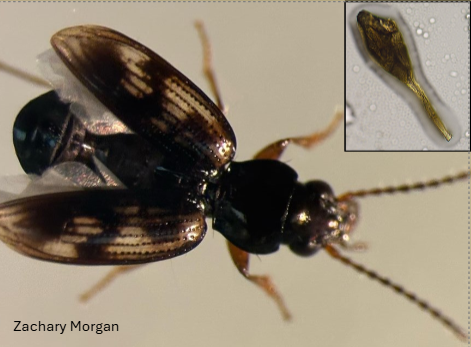
Beetle from the Carabidae family.
About Michael Malone
Michael Malone received his Master’s degree from the University of Wisconsin–La Crosse (UWL), where he studied Polynesian Xylariales. Previously, he studied Laboulbeniales at Syracuse University during his undergrad and will be studying novel fungi of the New Jersey Pine Barrens at Rutgers University this fall. In general, he likes to study the ecology and phylogenetics of obscure fungi, particularly within the Ascomycota.
You can see Michael’s presentation to the MMS on our YouTube channel.