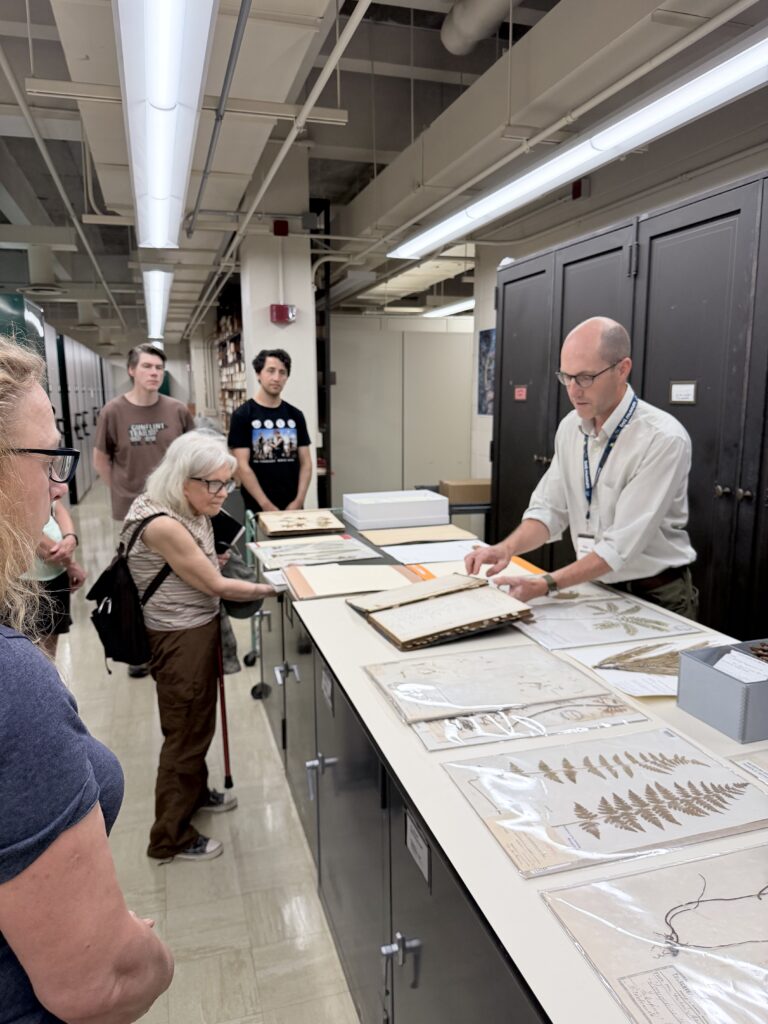
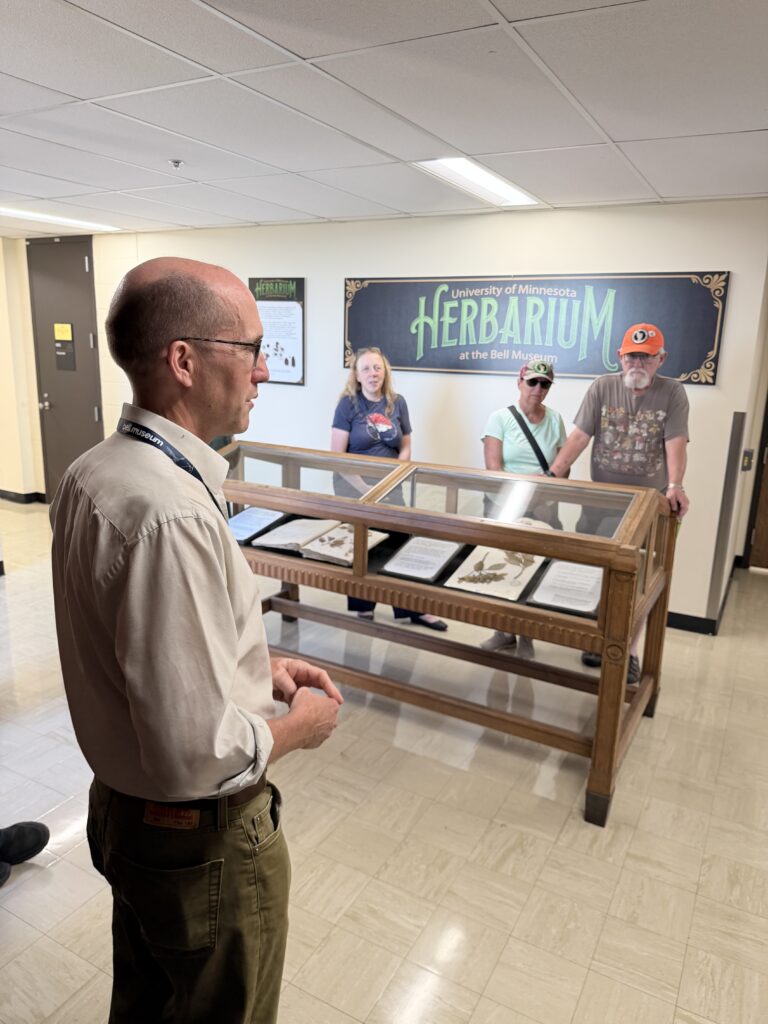
In early June, about a dozen of us from the Minnesota Mycological Society spent an evening behind the scenes at the University of Minnesota Herbarium at the Bell Museum, on the St. Paul campus. We went as members of the Funga Scientific Committee, and our host was Tim Whitfeld, the Herbarium Collections Manager, who walked us through how a working research collection documents and preserves the natural history of the state, one specimen at a time.
The herbarium is the largest plant and fungal collection in Minnesota, with roughly 940,000 specimens, and it holds the largest bryophyte collection in North America. The holdings come from students, faculty, field botanists, private collectors, and citizen scientists, spanning the early 1800s to the present.
How a specimen becomes part of the collection
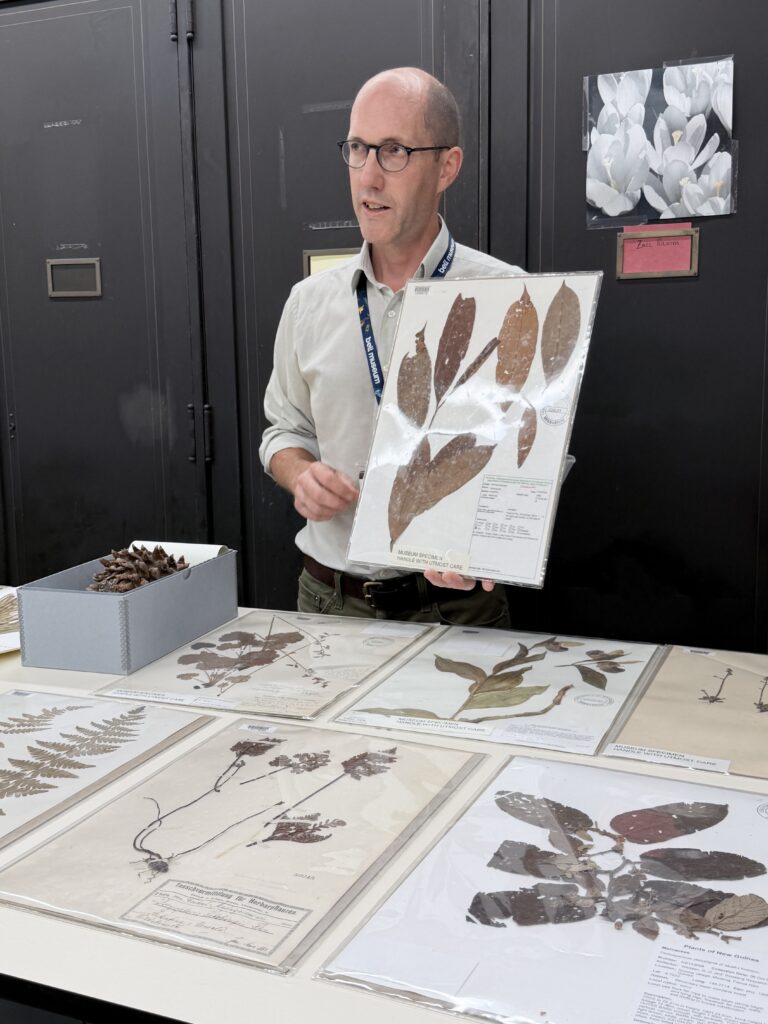
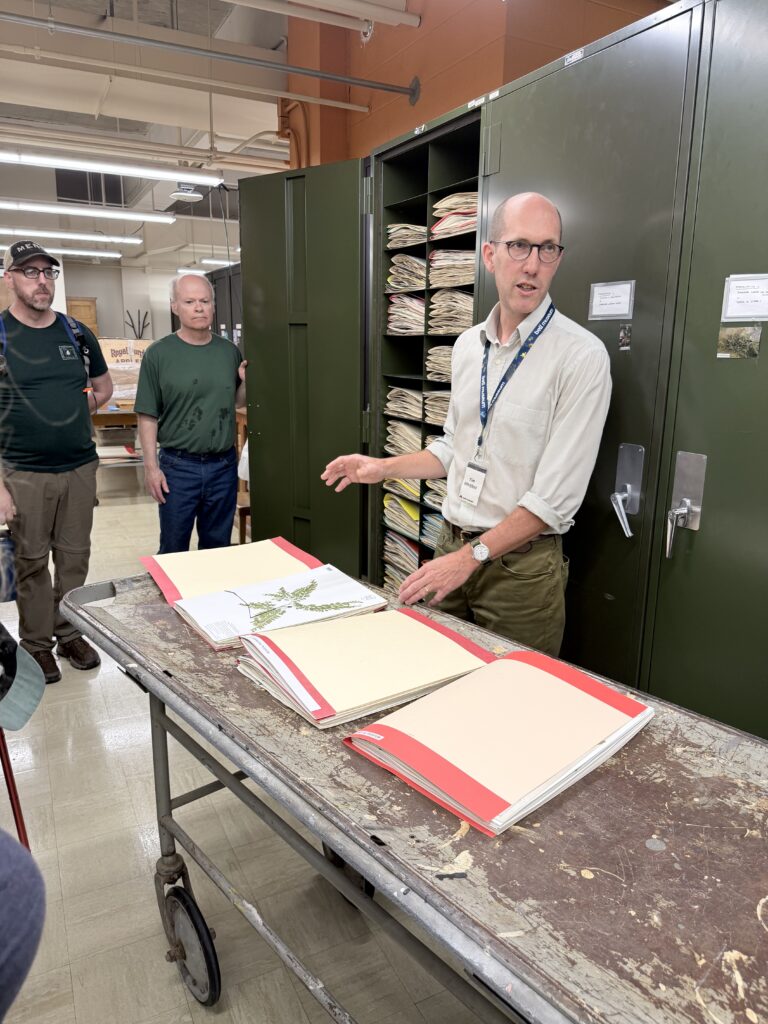
Tim showed us the full path a specimen travels. Dried material comes in, and students mount each piece by hand on archival paper, securing it with glue and small strips of tape. The mounted sheets are filed in folders inside large cabinets, organized by species, and slipped into clear plastic sleeves when they are pulled out for handling. Every specimen is photographed and digitized for the Minnesota Biodiversity Atlas, the Bell’s public database, where it is assigned an accession number that links the physical sheet to its label data and keeps it findable through subsequent moves.
That digitization effort is substantial. The Atlas launched in 2016 and now holds more than two million records and over 500,000 images, drawn from all 87 Minnesota counties. Everything that comes into the collection is first deep-frozen to kill any mold, insects, or other pests before it goes near the rest of the holdings. A single contaminated specimen could spread damage through an irreplaceable collection, so the freezer is the first stop.
There is one more category of specimen worth mentioning. For a certain number of species, the Bell holds the type specimen, the single physical specimen a species name is permanently tied to. It is the reference point every other identification of that species is measured against, and it is among the most valuable material any herbarium can hold.
Arranged like the tree of life
The cabinets are not arranged alphabetically. They are organized phylogenetically, by evolutionary relationships, so that closely related species sit near one another, as they branch on the tree of life. It is an elegant system, and Tim was candid about the headaches it creates. When a species is reclassified and renamed, its specimens may have to be physically relocated to sit with their new relatives. And when a large donation of a single species arrives, the staff sometimes have to shuffle whole runs of the collection to make room and keep everything in order.
Two specimens worth the trip
Tim brought out sheets that put the collection’s age and reach into perspective.
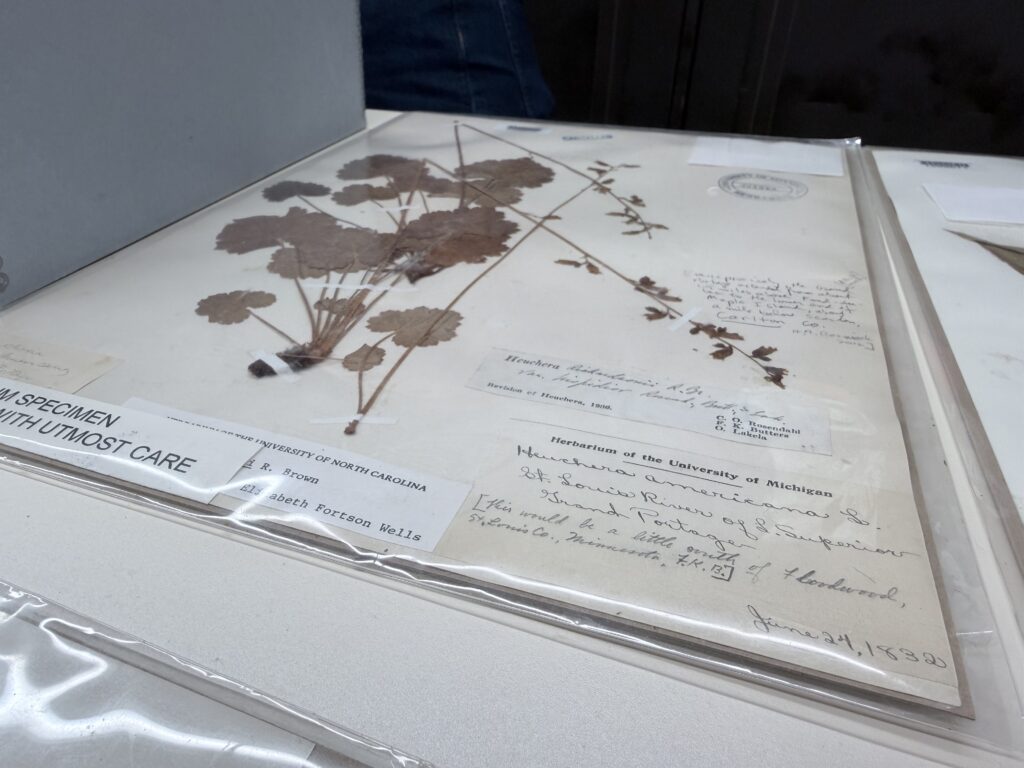
The oldest specimen we saw was a Heuchera, an alumroot, collected along the St. Louis River near Grand Portage of Lake Superior in St. Louis County, a little south of Floodwood, on June 24, 1832. It was gathered 26 years before Minnesota became a state. The sheet carries its original handwritten label from the Herbarium of the University of Michigan, along with a later annotation from the 1936 Revision of Heuchera by Rosendahl, Butters, and Lakela.
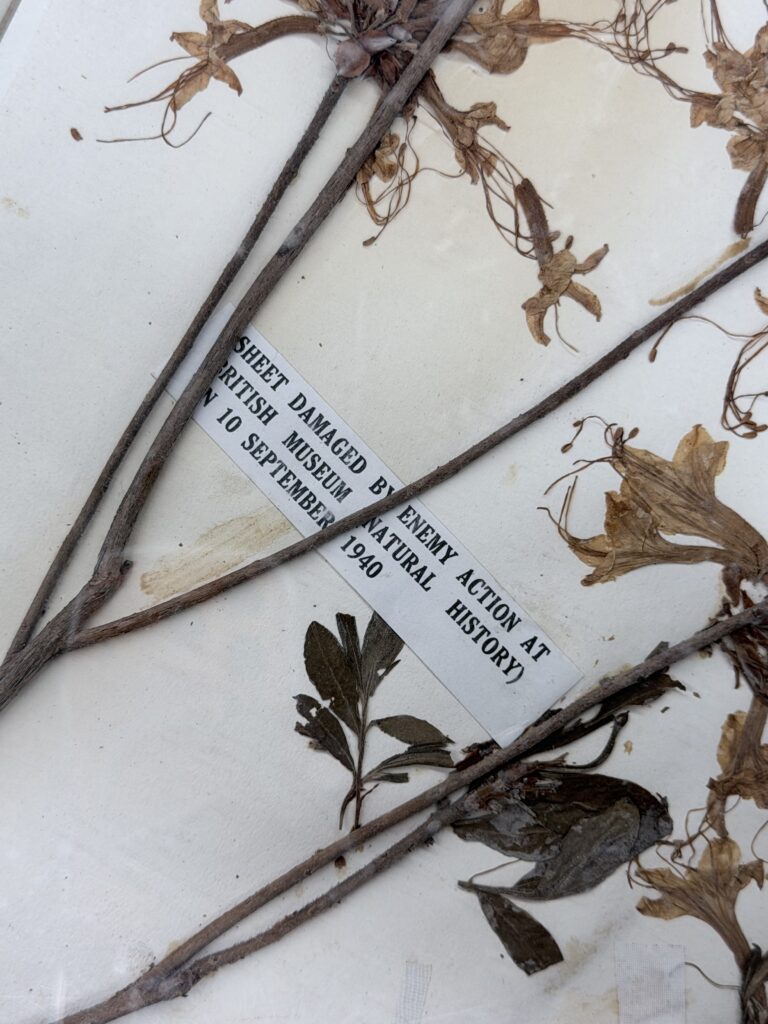
Another sheet carried a piece of history of a different kind. It is an azalea, labeled Azalea canescens, collected near Tallahassee, Florida, in 1843, that came to Minnesota via the British Museum. Across the specimen is a printed label: “SHEET DAMAGED BY ENEMY ACTION AT BRITISH MUSEUM (NATURAL HISTORY) ON 10 SEPTEMBER 1940.” It survived the Blitz and eventually found a permanent home in St. Paul.
The fungarium, and where MMS comes in
The fungarium is a wing of the herbarium rather than a separate building. Fungi are neither plants nor animals. They were historically shelved with plants because they grow from the ground and stay put rather than moving around, but they are their own distinct kingdom. They are also stored differently. Rather than being pressed flat onto sheets, dried fungi are kept as whole specimens in boxes, alongside the bulkier three-dimensional plant material that does not lie flat.
The fungal collection is growing, but fungi remain far less documented than plants. The Bell’s plant holdings number in the hundreds of thousands, while its fungal records sit closer to 76,000. The Funga Scientific Committee works to document Minnesota’s fungi more thoroughly, going deeper into identification through microscopy and DNA sequencing, tracking down rare and under-recorded species, and building vouchered records that the Bell can accession. It is citizen science in its most durable form: an observation in the field becomes a preserved specimen with data attached, available to researchers long after the foray is over.
Get involved
Our thanks to Tim Whitfeld and the Bell Museum for opening the doors and the cabinets. The care and attention behind every mounted sheet and boxed specimen was remarkable, and it was a reminder that the MMS is part of the long record this institution keeps.
If you would like to learn more about the Funga Scientific Committee, or get involved in documenting Minnesota’s fungi, you can find us at minnesotamycologicalsociety.org/funga-scientific-committee.
Written by Erica Tava Johnson, MMS Education Chair