
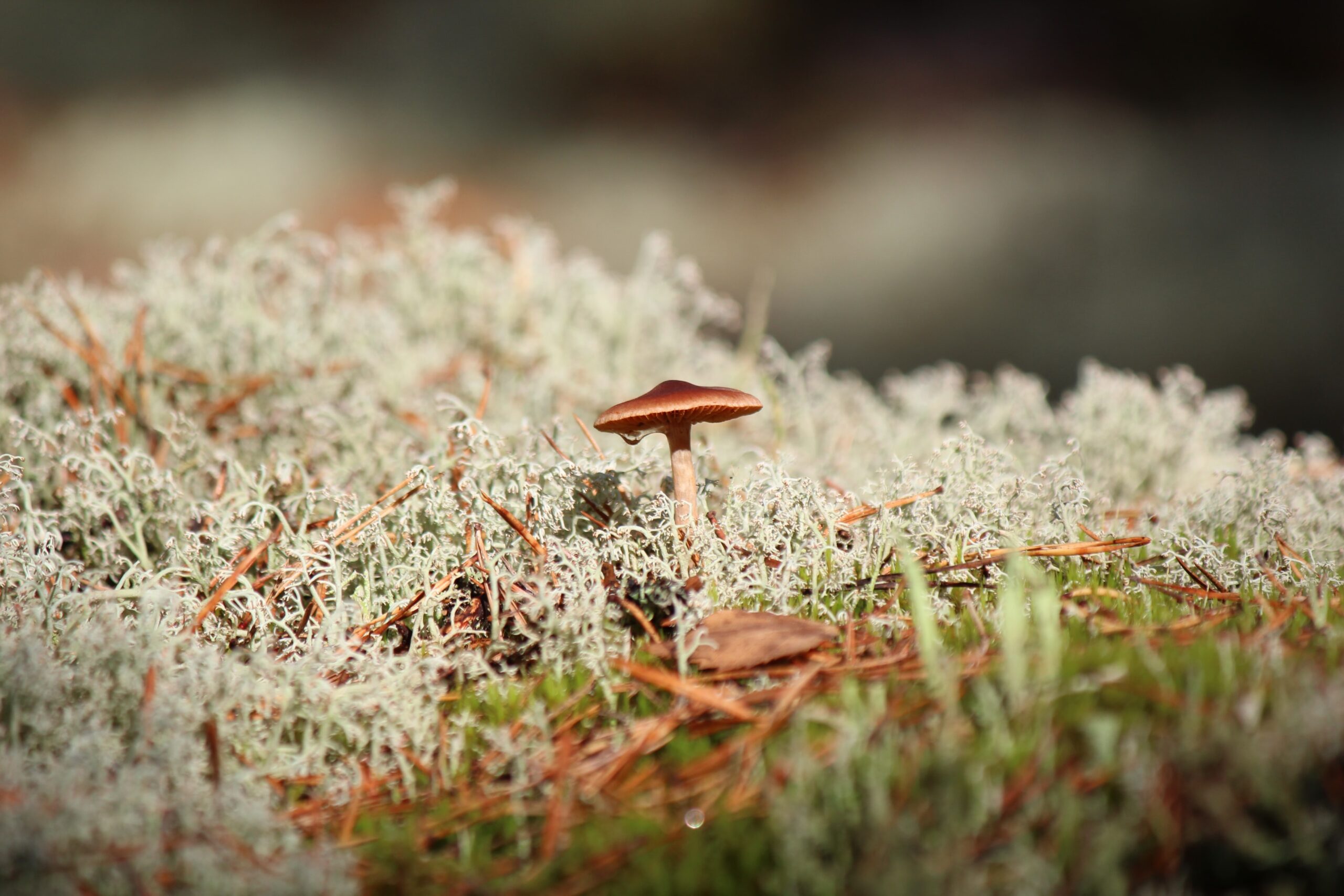
I think spore shapes are wonderous, and you should too.
About the Author
Hello! My name is Jason Raiti. I just graduated from the University of Wisconsin-Madison with my MsC in Botany. Beginning this fall (2026), I will be joining the Hynson lab, at the University of Hawaii Manoa for my PhD also studying mycology. Before any of that, I have worn many hats, including as a board member of several mycological societies, as a bioluminescent fungi researcher in Brazil, and in a past life as a computer scientist and roboticist. However, I will come to you today wearing a different hat. Let me explain.
I am writing this to you, dear reader, as I wait for a major surgery. I am going to have my kidney removed from my body and put in another person’s body. These kinds of events in one’s life tend to alter our perceptions of what is important. I have spent the last two years doing science in the ivory tower of academia and bookended with the public talk I did for the Minnesota Mycological Society, where I was invited to speak by the wonderful Kathy Yerich of “Mushrooms of the Upper Midwest” fame (my favorite local guidebook).
As such, I can’t help but reflect on my time before and what will come after, and how too much of science remains inaccessible. I remember two years ago, struggling to read research papers, and crack the code of jargon and self referentiality.
So, I come to you today, not as a scientist, or “Master” of mycology, but with my kid in a mushroom patch hat on. If you found this compelling and want to get in touch, find me here at raiti@hawaii.edu, or at my personal site (jasonraiti.org). If you want to get fresh mycological research in your inbox each week in digestible form, check out my project mycoweekly (mycoweekly.org). If you also love mycology and want people to love and pursue it indefinitely, check out the sclerotia project (sclerotiaproject.org). Anyhow, I hope after reading this, you go outside and wonder at what the heck all those adorable mushrooms (and spores) are doing.
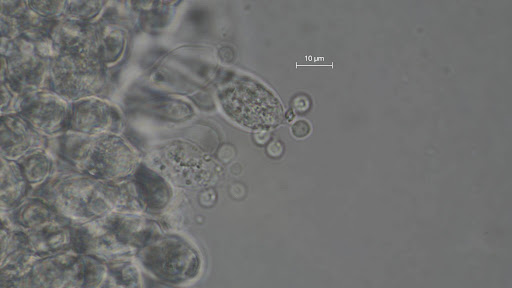
Beyond the Mushroom Cap: Discovering the Hidden World of Spores
When most people think about mushrooms, they think about caps, stems, colors, rings, volvas, gills, pores, smells, bruising reactions, and the eternal question: “Can I eat this, or will it ruin my week?”
Fair enough. But hidden beneath all of that, beyond what we can usually see with the naked eye, is another world of fungal beauty: spores.
Spores are the tiny reproductive units that mushrooms release into the world. They are, in one sense, the fungal equivalent of seeds. But unlike seeds, spores are usually microscopic, produced in mind-boggling numbers, and thrown into the world with very little luggage. A mushroom cannot walk its children to a good home. It cannot choose the perfect log, root tip, patch of soil, or mossy crevice. Instead, it makes spores, launches them into the air, and lets physics, weather, chance, and evolution do the rest. And unlike seeds, we actually know very little about fungal spores.
And here is the part I find so wonderful: spores are not all the same.
Some are round. Some are long and narrow. Some are curved like tiny sausages. Some are ornamented with spines, ridges, or bumps. Some are smooth as glass. Some are thick-walled and darkly pigmented, built like little armored survival capsules. Some come with one nucleus, some with several. Some come with endosymbionts, others sterile and pure.
At first glance, spore shape might seem like a small taxonomic detail, like the kind of thing you measure because a field guide tells you to. But the deeper I got into my research, the more I came to believe that spore shapes are so much more than meets the eye. They may be tiny records of how fungi solve one of the hardest problems in biology: how to get somewhere useful, survive long enough, and begin again.
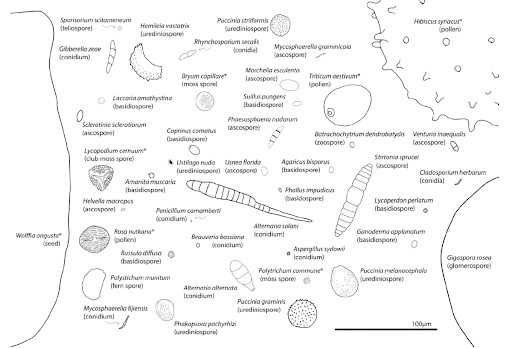
Studying Amanita Spores: Measuring the Shapes of Fungi
My master’s research focused on the mushroom genus Amanita, a group beloved, feared, and occasionally misunderstood by mushroom people everywhere. Amanita includes some of the most iconic fungi in the world: the red and white fly agaric, the deadly destroying angel, the death cap, and many strange, beautiful, lesser known species hiding in woods around us. It is also a wonderful group for studying spores because Amanita species have been described in detail by generations of taxonomists. Those descriptions often include drawings or images of spores.
Thus, thanks to generations of mycologists, and mycoenthusiasts, we now have an awesome dataset for asking “What are spore shapes for?”.
In total, I analyzed over 1,000 spore outlines representing more than 200 species. The goal was simple: instead of describing spores only with words like “globose,” “ellipsoid,” or “elongate,” we would measure them using something called morphometrics.
What Spore Shapes Reveal About Fungal Evolution
The biggest pattern was remarkably simple. Most of the variation in Amanita spore shape falls along one major spectrum of variation: from more elongate spores to more globose spores. You can think of this as an axis with a long narrow stick on one end and a beach ball on the other. In other words, much of the spore-shape diversity in Amanita can be understood as variation between “longer and narrower” versus “rounder and fuller.”
That may sound obvious for those of you who have observed these spores before, but it matters. Taxonomists have been describing this kind of variation for a long time. What quantitative shape analysis lets us do is test whether that familiar descriptive language corresponds to measurable biological patterns. Are rounder spores associated with certain ecological strategies? Are longer spores more common in certain environments? Does spore shape simply follow ancestry, or does it evolve again and again?
How Environment Influences Spore Shape
One of the most interesting patterns I found was that Amanita spore shape appears to be associated with precipitation. In my dataset, species collected from wetter conditions tended to have more elongate spores, while species from drier conditions tended to have rounder spores. Which begs the question, why would moisture and spore shape be connected?
One possibility is that rounder spores may be better at resisting drying out. A sphere is a very efficient shape: for a given volume, it has relatively little surface area exposed to the outside world (think cactus). Less exposed surface can mean less opportunity to lose water. For a microscopic spore trying to survive in a dry environment, that could matter.
On the other hand, more elongate spores may behave differently in air, on surfaces, or in water. They may settle differently, attach differently, or interact differently with rain, soil, leaf litter, or the tiny chaotic air currents around a mushroom. A spore does not live in our human scale world. It lives in a world where a slight change in shape may alter how it falls, sticks, dries, hydrates, or begins to germinate.
The Amazing Journey of a Fungal Spore
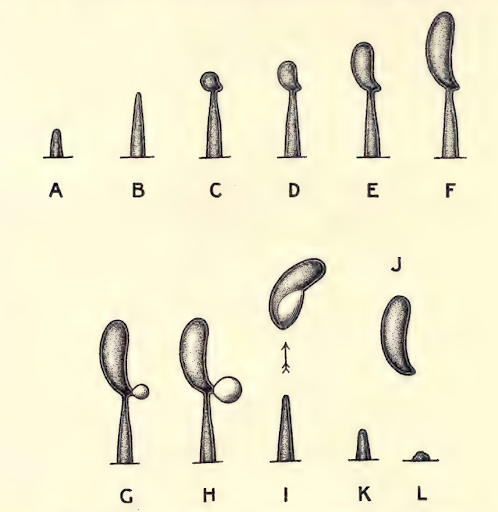
A fungal spore must do several things astonishingly well. It must be launched from the mushroom. It must escape the crowded, still air around the fruiting body. It must travel, sometimes only a few inches, sometimes much farther. It must land somewhere that is not useless. Then, if conditions are right, it must germinate and grow. For mycorrhizal fungi, that may mean finding a compatible plant root. For wood-decay fungi, it may mean landing on the right kind of dead wood at the right stage of decay. For litter decomposers, it may mean reaching the forest floor and entering a world already crowded with competitors.
That is a lot to ask of something smaller than a dust mote.
Why There Is No Perfect Spore Shape
And so, spore shape may reflect trade-offs. A small spore may travel farther, but carry fewer reserves. A large spore may have more resources for survival and germination, but may not disperse as easily. A round spore may resist drying. An elongated or curved spore may attach better to certain surfaces. Ornamented spores may catch on soil animals or move through the world in ways smooth spores do not. Thick-walled spores may survive harsh conditions, but may take more energy to build.
There may be no single “best” spore shape. There are only different problems, different environments, and different fungal ways of making a living.
That is one of the lessons I hope people take from this research. Evolution does not produce beauty separately from function. Often, the form is the function. The shapes we admire under the microscope may be the visible impressions of invisible forces: moisture, gravity, air movement, host roots, animal vectors, bark, soil, time, and chance.
Exploring Spore Shapes at Home
And you do not need a fancy research lab to begin noticing this world!
Yes, my project used computers, mathematical shape analysis, phylogenies, and far too many spreadsheets. But the doorway into this whole universe is much simpler than that. All you really need is a cheap microscope, a spore print, and a lot of patience.
Take a mushroom you can identify confidently. Make a spore print. Put a little material under the microscope. Look carefully. Are the spores round? Lemon-shaped? Almond-shaped? Long and narrow? Curved? Smooth? Warted? Thick-walled? Transparent? Brown? Do they all look the same, or is there variation?
Then write it down. Draw what you see. Take photos if you can. Share them with other mushroom people. Compare species. Compare habitats. Compare fresh collections with older ones. Ask whether the spores of wood-decay fungi look different from the spores of mycorrhizal fungi. Ask whether mushrooms fruiting in dry weather have spores that differ from those fruiting in wet weather. Ask wonderfully nosy little questions.
The Wonder of Looking Closely at Fungi
That, to me, is the heart of mycology. It is not only naming mushrooms, though naming is important. It is not only eating mushrooms, though that is often delicious. It is learning how to look closely at a living world that is much stranger, smaller, and more inventive than we usually imagine.
So the next time you make a spore print, do not stop at the color. That print is not just a diagnostic tool. It is a pile of microscopic travelers. Each one is a possible future fungus. Each one carries a shape carefully sculpted by ancestry, chance, physics, and ecology.
And tell your friends: I think spore shapes are wonderous, and you should too!
Jason is an MMS 2026 Graduate Student Scholarship recipient. You can see the talk that Jason presented to the MMS on our YouTube Channel. His talk begins at the 32:20 point.